Sample: IMDb-style mini bio + podcast interview structure
Illustrative sample by Alex Mercer. Subject: Buster Keaton (1895–1966), a historical public figure, chosen so the format can be shown without using any client's private details. Facts are from public sources (Wikipedia's "Buster Keaton" article and the references it cites: Meade 1997, Curtis 2022, The New York Times obituary, Feb 2, 1966). For a client, the same two pieces are built only from their own credits and notes, and every claim is checked against their IMDb page.
Format rules followed (IMDb mini-bio style): third person, factual, no promotional adjectives, no unverifiable claims, no contact details or links, and stories that might be legend are labeled as such.
1. Short mini bio (about 100 words)
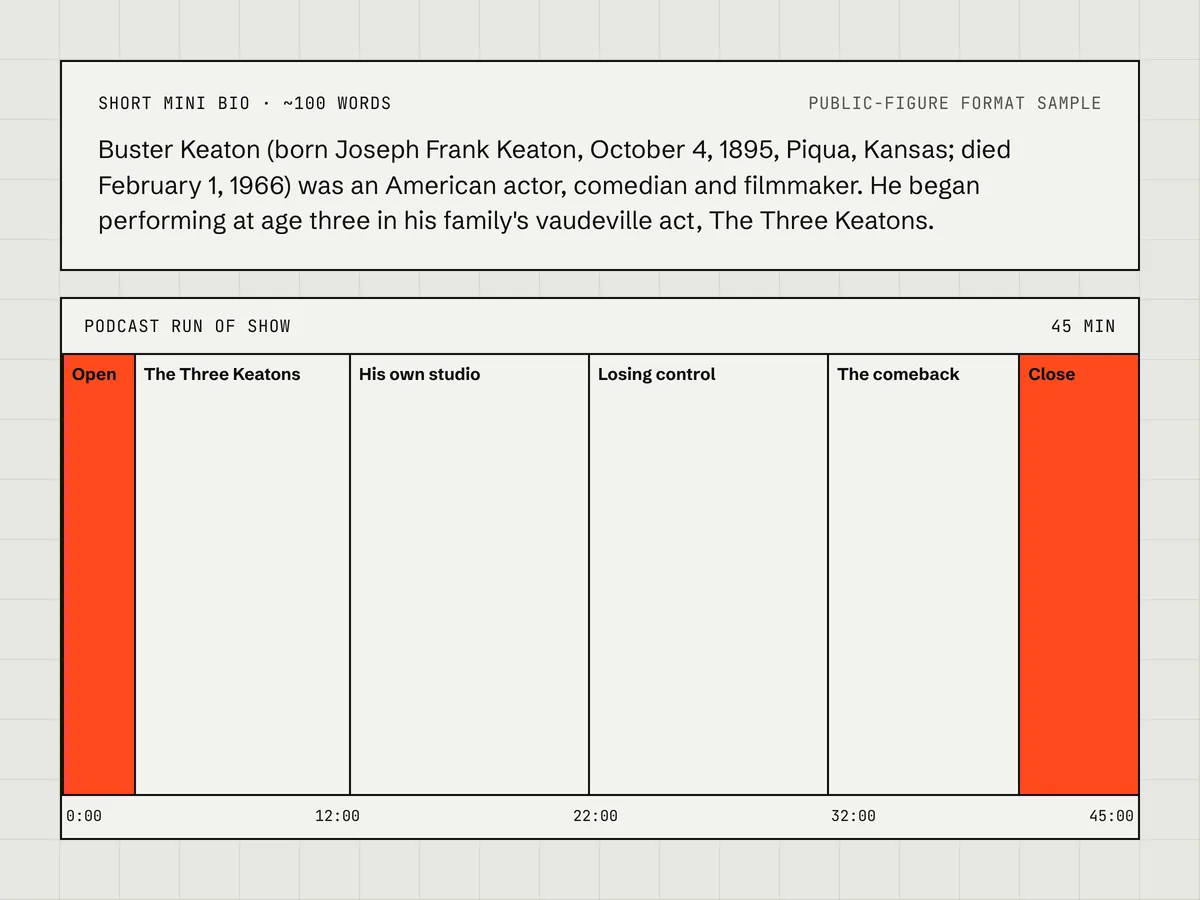
Buster Keaton (born Joseph Frank Keaton, October 4, 1895, Piqua, Kansas; died February 1, 1966, Woodland Hills, California) was an American actor, comedian and filmmaker. He began performing at age three in his family's vaudeville act, The Three Keatons. In 1917 he made his film debut opposite Roscoe Arbuckle in The Butcher Boy, and from 1920 he led his own production unit, making two-reel comedies such as One Week (1920) and Cops (1922) and features including Sherlock Jr. (1924) and The General (1926). Known for his deadpan expression and for performing his own stunts, he received an Honorary Academy Award for 1959.
2. Full mini bio (about 330 words)
Buster Keaton was born Joseph Frank Keaton on October 4, 1895, in Piqua, Kansas, into a traveling vaudeville family. From age three he performed with his parents in The Three Keatons, a knockabout comedy act in which he learned to take falls safely. A frequently told story, possibly apocryphal, credits the nickname "Buster" to a fall he survived as a toddler.
In February 1917 he met Roscoe "Fatty" Arbuckle in New York and appeared in his first film, The Butcher Boy, the same year. He went on to appear in 14 Arbuckle shorts. During World War I he served in France with the U.S. Army's 40th Infantry Division.
In 1920 producer Joseph M. Schenck gave him his own unit, Buster Keaton Productions. He made 19 two-reel comedies, including One Week (1920), The Playhouse (1921) and Cops (1922), then features including Our Hospitality (1923), Sherlock Jr. and The Navigator (both 1924), The General (1926) and Steamboat Bill, Jr. (1928). He performed his own stunts and built his screen character around a deadpan expression, which earned him the nickname "The Great Stone Face."
In 1928 he signed with Metro-Goldwyn-Mayer, where he lost creative control. After personal difficulties he was released by the studio in 1933. He continued working in shorts for Educational Pictures and Columbia, as a gag writer at MGM, and in character roles, including appearances in Sunset Boulevard (1950) and Charlie Chaplin's Limelight (1952). Television work in the 1950s and the re-release of his silent films renewed interest in his career, and he received an Honorary Academy Award for 1959, presented in April 1960.
He married Natalie Talmadge in 1921 (divorced 1932), with whom he had two sons; Mae Scriven in 1933 (divorced 1936); and Eleanor Norris in 1940, to whom he remained married until his death. He died of lung cancer on February 1, 1966, in Woodland Hills, California. Six of his films have been added to the National Film Registry.
3. Podcast interview structure (run of show, ~45 minutes)
Written as if the guest could answer, to show the structure. For a client, every segment is drawn from their own bio and the talking points they want to land.
Goal of the episode: the guest leaves listeners with one idea: "the best comedy is simple, and the danger was real." Three talking points to land: (1) the vaudeville training behind the falls; (2) why owning his own unit mattered; (3) what he'd tell a filmmaker giving up control for security.
| Time | Segment | Host prompt / purpose |
|---|---|---|
| 0:00–1:30 | Cold open | Play or describe the Steamboat Bill, Jr. house-front stunt. Host: "Two tons, a window, a few inches of clearance. Why do it yourself?" |
| 1:30–3:00 | Intro | Host reads the short bio above (written to be read aloud in about 40 seconds). |
| 3:00–12:00 | Story 1: The Three Keatons | How a child act taught him to fall; the "can't be damaged" billing; when the deadpan started. |
| 12:00–22:00 | Story 2: His own studio | Meeting Arbuckle; taking a camera apart overnight; writing his own gags; The General and its expensive bridge shot. |
| 22:00–32:00 | Story 3: Losing control | The MGM contract he later called his worst business decision; what changed day to day. |
| 32:00–40:00 | Story 4: The comeback | Gag writing, television, the 1959 honorary award; what rediscovery felt like. |
| 40:00–44:00 | Lightning round | Five quick questions (below). |
| 44:00–45:00 | Close | Where to watch his work; land talking point 3. |
Core questions (with follow-ups):
- You were on stage at three. What's your earliest memory of an audience? Follow-up: When did you notice they laughed less if you smiled?
- How do you take a fall that looks deadly and isn't? Follow-up: Which one actually hurt?
- You took a borrowed camera apart the night you were hired. What were you looking for?
- Who wrote your best gags? Follow-up: Did writers ever pitch a gag you refused?
- The General is now called one of the greatest films ever made, but it lost money. How did that land at the time?
- What did MGM's script for The Cameraman look like when you first got it? Follow-up: What did you cut?
- Chaplin and Lloyd told you not to sign. Why did you?
- What was the hardest part of being a gag writer for other comedians?
- Television brought you a new audience. Did you change anything for the small screen?
- If you could re-release one film that people overlook, which one and why?
- What should a young filmmaker trade for security, and what should they never trade?
Lightning round: favorite prop; train or boat; best stunt you didn't get credit for; one comedian working today you'd hire; how many hats per film.
Host notes: keep questions open; let pauses run (the guest's style is understatement); flag the "Buster" nickname story as family legend if it comes up.
Sample prepared by Alex Mercer. Not affiliated with IMDb.